Manual or Automatic: What Should UK Learner Drivers Choose in 2026?
February 26, 2026
The motor industry is undergoing a seismic shift. With the UK government’s ban on new petrol and diesel car sales due in 2030, the choice between manual and automatic gearboxes is rapidly disappearing — and learner drivers are at the forefront of this transition.
1. The Decline of Manual Cars in the UK Market
Manual gearboxes are rapidly shrinking in the UK new-car market:
- In 2025, there were just 82 new car models available with manual transmissions from the UK’s top manufacturers — a 57% drop since 2015(192 models) and an 8% drop year-on-year from 2024. Manual-equipped models now represent just 29% of new model offerings. (CarGurus)
- Many major brands no longer offer manuals at all — including Mercedes-Benz, Land Rover, Volvo, Tesla, MINI and Lexus. (CarGurus)
- Industry analysts report that manual options are at their lowest in a decadeand continuing to contract as automatics surge in popularity. (Motor Trade News)
This decline isn’t temporary — it’s structural and tied directly to electrification and regulatory change. With electric vehicles (EVs) inherently automatic, the very nature of future new cars is shifting.
2. New Car Sales: Automatics Take the Lead
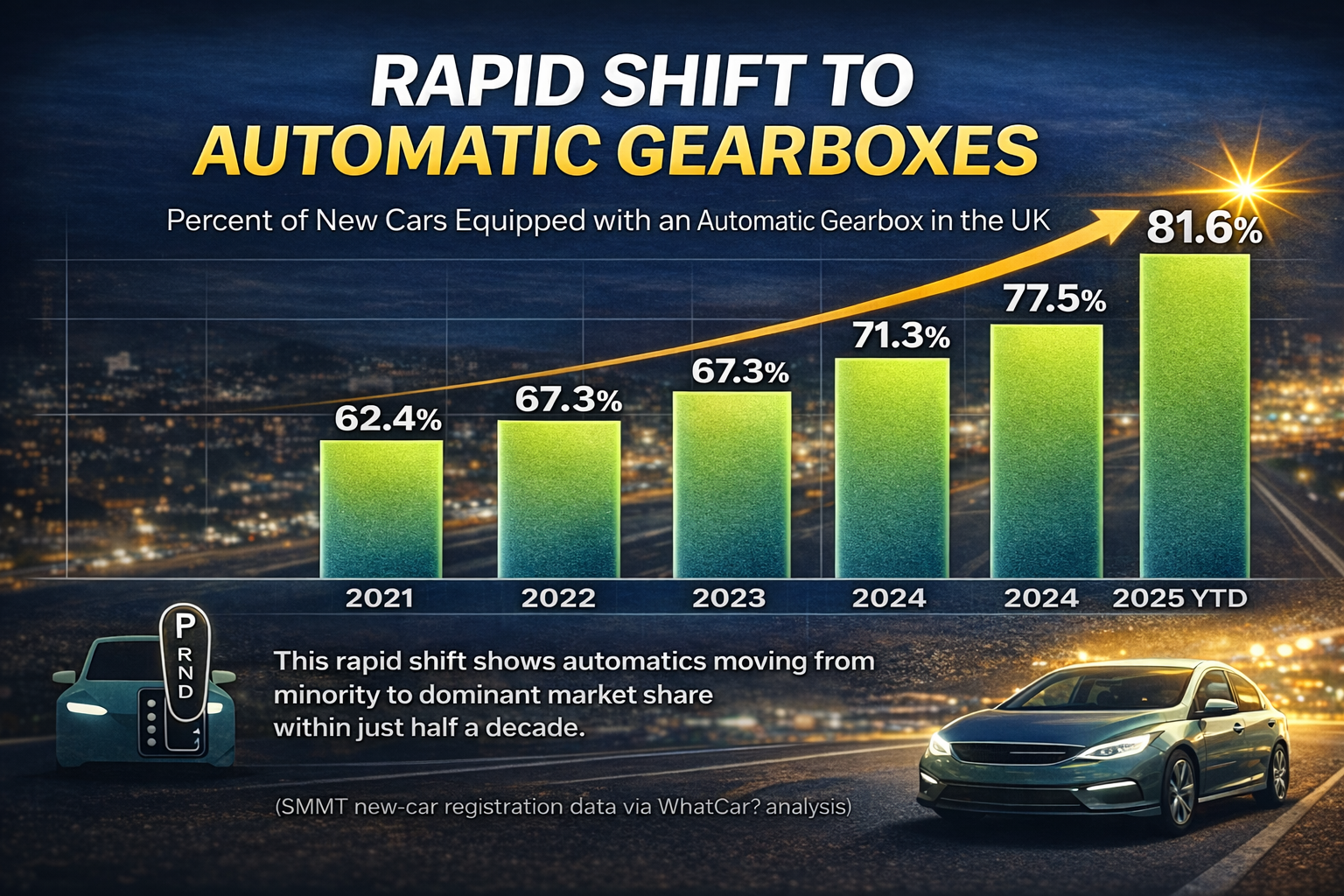
Official industry data shows a clear trend:
3. Learner Drivers Driving the Trend: DVSA Test Figures
Driving test data from the Driver and Vehicle Standards Agency (DVSA)bolsters this trend:
Growth in Automatic Driving Tests
- A decade ago (2012/13), just 6% of UK driving tests were in automatic cars. (Driving Instructors Association)
- By 2023/24, that figure had risen sharply to 23.4%. (The AA)
- In 2024/25, approximately 26% of practical driving tests were taken in automatic vehicles — nearly 480,000 automatic tests out of 1.8 million total. (Auto Express)
Industry forecasters expect this share could reach one third of all tests by 2026/27 if current trends continue. (Driving Instructors Association)
What This Means for Learners
Choosing to test in an automatic limits your licence to automatic-only vehicles unless you later take a second manual test. Conversely, learning in a manual vehicle gives full flexibility — a major strategic decision for today’s learner drivers. (GOV.UK)
4. Why Learners Are Switching to Automatics
There are several key reasons:
a. EV Adoption
All electric cars are automatics — and with the 2030 ban on new petrol/diesel sales looming, learners are increasingly choosing gearboxes that match the cars they expect to own. (Driving Instructors Association)
b. Rising Share of Automatics on UK Roads
Cap Hpi reports automatic vehicles now make up almost one-third of the UK’s total car parc, climbing over 118% in the last decade. Meanwhile, manual volumes have stagnated or begun to decline. (Fleet News)
c. Easier Driving, Faster Confidence
Learners often find automatics simpler to master — no clutch or gear changes to coordinate — allowing earlier focus on road positioning, hazard perception and overall driving skill.
d. Instructor Shifts
The UK driving instruction industry itself is adjusting — with increasing numbers of instructors teaching only in automatic cars as demand rises and manuals become rarer. (The Guardian)
5. Call to Action: What Should Learner Drivers Do in 2026?
For Today’s Young Drivers
If your priority is future readiness, ease of learning and alignment with the cars you’re likely to drive (especially EVs), automatic lessons make strategic sense.
For Drivers Who Value Flexibility
Learning in a manual car still offers advantages:
- Full licence rights (you can drive either manual or automatic).
- Better adaptability for used car purchases (many affordable used cars are still manual).
- A deeper understanding of vehicle dynamics.
However, manual options in the new car market are shrinking rapidly and may become niche long before the 2030 ban kicks in — meaning manual experience could be harder and more expensive to obtain. (CarGurus)
For Driving Instructors and Industry Stakeholders
The shift toward automatic transmissions — and specifically electric automatics— is more than a fad; it’s a reflection of regulatory direction and consumer preference. Instructors should adapt their offerings to meet changing demands while preserving manual licence opportunities where feasible.
6. Final Thoughts
As the UK transitions toward electrification and away from internal combustion engines, the manual gearbox — once a rite of passage for every learner — is becoming a rarity. With automatic tests rising steadily, new cars increasingly automatic-only, and learners planning their driving futures around EVs, the question is no longer if manual will fade but how swiftly it will happen.
For learner drivers in 2026, choosing automatic could be the smart, forward-looking choice — but those who prize traditional skills and maximum flexibility may still see benefit in going manual while they still can. Find out more about our ⛓️💥🛜 Automatic Driving Lessons here